How Casino Scenes Change Meaning Across Cultures
Casino scenes across cultures reveal how screen language shapes a venue’s mood. Compare camera, sound, dialogue, and subtitles without reducing a culture to one scene.
Why can the same casino scene feel like a celebration to one viewer and a warning to another? Casino scenes across cultures build meaning through screen language: the rhythm of a cut, a musical cue, a repeated image, or a subtitle that changes how a line lands.
Casino scenes across cultures use genre signals to shape mood
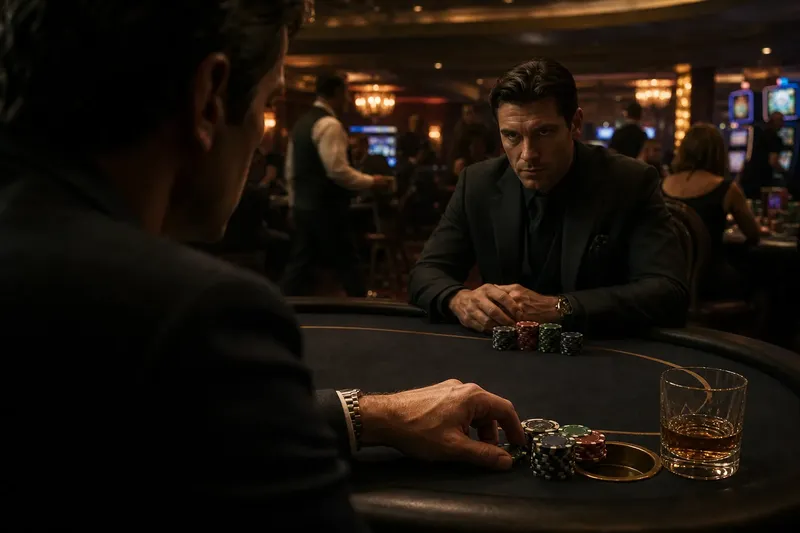
A glittering entrance, a slow reveal of the gaming floor, or a sudden cut to a character’s face can make a casino feel like spectacle before anyone touches a card. Those choices draw on film conventions as much as on the setting itself. A lavish arrival may signal fantasy; a clipped exchange and a tight frame may turn the same room into a pressure chamber.
Listen for what the scene borrows from its genre. A crime story may use hushed dialogue and watchful glances. A comedy may let an awkward pause or an overconfident gesture carry the joke. These signals travel across borders, but a particular audience may recognize some references more readily than others. Describe the cue before deciding what it means.
Editing and sound can make the same action feel different
Editing controls what viewers know and when they know it. A sequence that cuts quickly between a player, a companion, and the table can spread attention across the room. A sustained shot may leave viewers waiting with one character. Neither style has a fixed cultural meaning; each is a formal choice whose effect depends on the scene around it.
Sound adds another layer. Chips clicking, room conversation, silence, and music can be foregrounded or pushed aside. If the soundtrack swells as a character makes a decision, the moment may feel momentous. If ordinary conversation continues, the action may seem routine within that story. These are cues to analyze, not proof of how any real audience regards gambling.
Subtitles and dubbing can alter a scene’s comic or dramatic timing
Translation carries more than plot. A teasing nickname, an honorific, or a deliberately stiff phrase can establish a relationship. A subtitle may preserve the literal wording but lose the joke’s timing; dubbing may choose a smoother phrase that changes how familiar the speakers sound.
Pay attention to the gap between words and performance. A character’s pause, grin, or quick reply may suggest playfulness even when the subtitle reads neutrally. For game terminology, translators may retain a specialized term, briefly explain it, or use a broader expression. Each choice changes what the audience is expected to understand at once.
What should you compare in a casino scene?
Which genre cues shape the scene’s mood?
Note the music, lighting, pacing, and recurring images before naming the mood. A bright room with ominous music may create tension rather than glamour, so read the cues together.
How does editing direct your attention?
Track whether cuts follow one character or move among the table, companions, and staff. That pattern shows where the scene places attention, without establishing a rule about a national film tradition.
What changes between the original dialogue and subtitles?
Compare the translated wording with pauses, gestures, and the next character’s response. Record a possible shift in humor or formality as a translation choice, not as a complete account of the original language.
Does sound make the venue feel public or private?
Listen for whether room noise stays present or fades beneath music and close dialogue. The mix can make a character seem surrounded by company or sealed inside a private moment.
A close comparison keeps interpretation tied to evidence
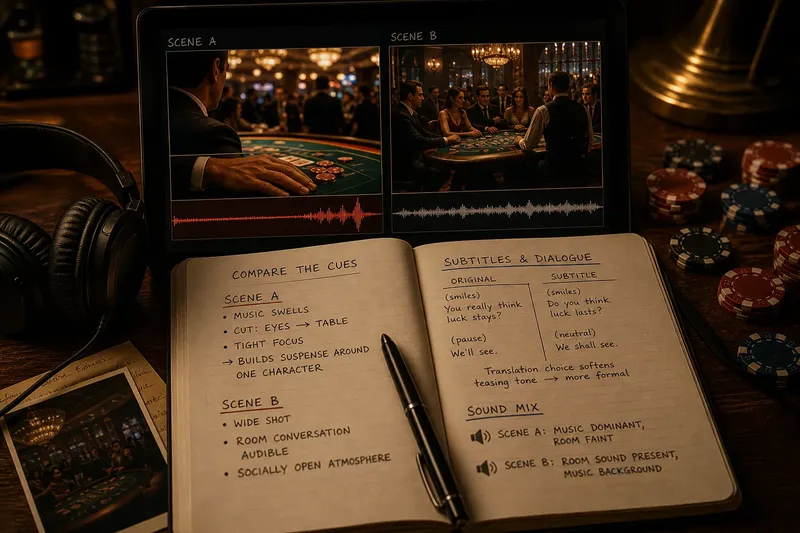
Imagine a class is comparing two invented scenes. In Scene A, a character approaches a card table while the music grows louder; the camera cuts from the character’s eyes to a hand resting on the table. In Scene B, the camera stays wide as companions talk, and room conversation remains audible. The hypothetical starting details are those specific images and sounds, not claims about actual films.
For Scene A, the student writes down the music change and the two cuts, then decides that the sequence builds suspense around one character. For Scene B, the student records the wide framing and audible conversation, then decides that the moment feels more socially open. The student checks the subtitles against each character’s pauses and replies; if a joke reads as formal, the note is that translation may have softened the humor. The observable output is a comparison of two scenes’ techniques, not a verdict about how people from any culture think.
Separate screen conventions from claims about audiences
A scene can be analyzed closely without turning it into a cultural shortcut. Start with its visible and audible choices, then distinguish observation from interpretation. If a film’s broader context matters, look for reliable information about its genre, intended audience, production, and translation rather than treating one scene as representative.
For a useful final note, name the technique that changed your reading: a cut that withheld information, a soundtrack that recast a gesture, or a subtitle that shifted a relationship’s tone. That specific observation gives casino scenes across cultures a sharper comparison—and leaves room for viewers to disagree about the effect.