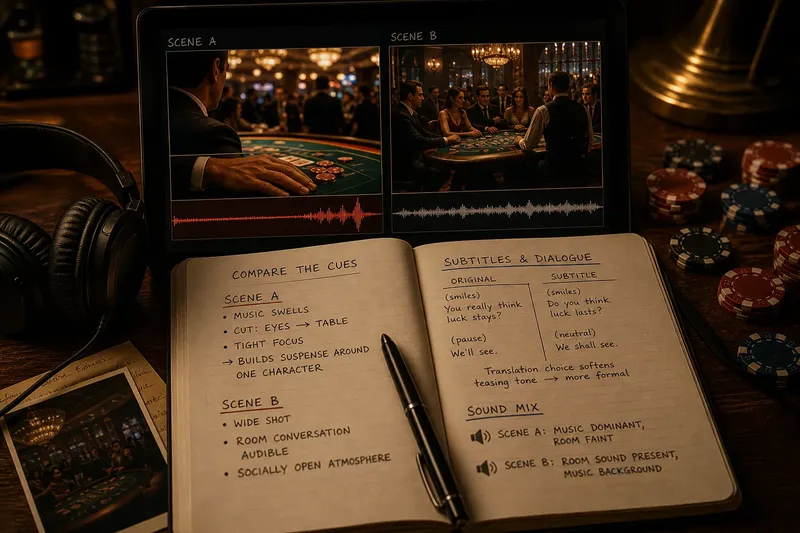
How to Read Casino Scenes Across Cultures
Read casino scenes across cultures by tracing how translation changes the stakes, jokes, and social meaning of a line without mistaking fiction for fact.
What changes when a casino scene crosses languages? To read casino scenes across cultures, listen for the words that subtitles keep, reshape, or leave out. A greeting may become more formal, a joke may lose its double meaning, and a term for a game may carry no obvious equivalent.
That makes translation—not a broad claim about how a culture behaves—the sharpest lens. A scene’s meaning can shift between dialogue, subtitles, dubbing, and the viewer’s assumptions. Comparing those versions shows how language steers the story.
Track the line from speech to subtitle
Subtitles must fit on screen and move at the pace of dialogue. A translator may shorten a sentence, replace an idiom, or omit a repeated phrase. Those choices can change whether a character sounds deferential, blunt, playful, or confused.
Compare a line in the original audio with its subtitle, if both are available. Note the words that differ and what the change does in context. Avoid treating a concise subtitle as evidence that a character’s language or social style is naturally terse.
Notice when a joke depends on local wording
Casino scenes often use wordplay around luck, money, risk, and reputation. A pun may become a plain statement in translation, while a joke that relies on a local expression may be replaced with a different joke. The plot can remain intact even as the character’s voice changes.
Pay attention to the response as well as the line. Does another character laugh, pause, or answer seriously? That reaction helps show how the film wants the exchange to land, though it cannot recover every nuance lost in translation.
Separate game vocabulary from social meaning
Terms for cards, chips, bets, and turns can be technical, informal, or venue-specific. A subtitle may use a familiar general term where the original uses a specialized one. That can make the action easier to follow while flattening a distinction important to the scene.
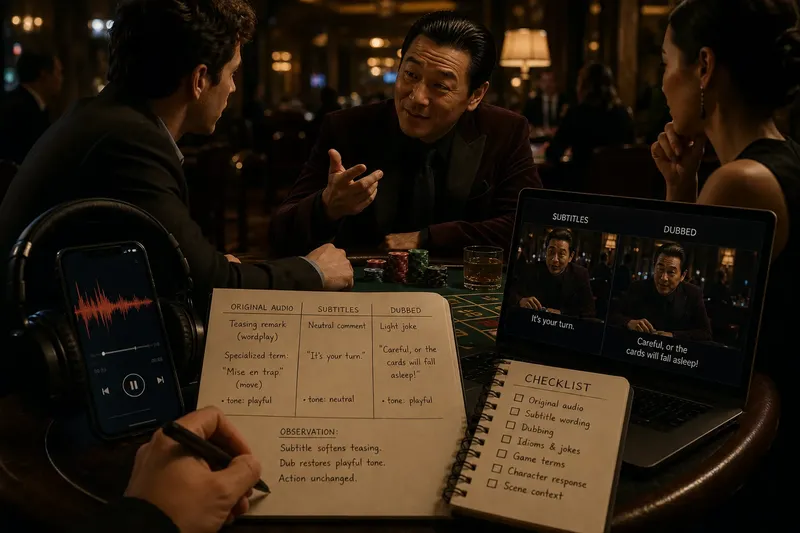
Imagine an invented scene in which a character uses a specialized term for a move, but the subtitle says only “your turn.” Write down the original term, the subtitle, and the action shown on screen. The result is a clear observation: the translation simplifies the vocabulary. It does not establish what players in any real place would say.
Compare versions without turning differences into cultural rules
When a film has subtitles and dubbing, compare the same exchange in both. Dubbing may alter a phrase to match an actor’s timing; subtitles may compress it. Neither version is automatically more faithful in every respect.
Say you have an invented scene with two versions. In the original, a host makes a teasing remark about a guest’s cautious play. The subtitle renders it as a neutral comment, while the dub uses a light joke. Record the three lines, then note that the subtitle softens the teasing and the dub restores a playful tone. Your conclusion concerns these versions of this scene, not the humor of a whole language community.
Which translation details matter most?
Should I trust subtitles or dubbing more?
Neither format preserves every feature of the original. Compare each version with the audio when you can, and describe the specific difference rather than declaring one universally accurate.
What if I cannot understand the original dialogue?
Use available subtitles or translations as evidence about the versions you can access. Mark uncertainty about the original wording instead of guessing at a pun or cultural reference.
How do I tell a translation choice from a plot change?
Compare the line with the action and the next response. If the wording differs but the same event follows, note a possible shift in tone or emphasis; if the action also changes, describe both without assuming why.
Can a translated scene explain real casino etiquette?
It can prompt a question, but it cannot establish a venue’s actual rules or customs. For practical information, consult the venue’s published guidance or a qualified local source.
Use a translation comparison checklist
For each item, record what is observable and choose a claim that matches it. If the material is unavailable, leave the question open rather than filling the gap with an assumption.
- Original audio: Check whether you can hear the source-language line. If it is clear, write down the relevant words; if it is not, mark the wording as uncertain and compare only accessible versions.
- Subtitle wording: Check which words appear on screen. If a phrase is shortened or replaced, describe the change; if it closely matches the audio, do not claim a major wording shift.
- Dubbing: Check whether a dubbed track is available and how it phrases the line. If it differs from the subtitle, record both; if no dub is available, limit the comparison to audio and subtitles.
- Idioms and jokes: Check whether the line relies on wordplay or an expression. If the wording changes, note the possible loss or replacement; if no such feature is apparent, avoid calling an ordinary line a mistranslated joke.
- Game terms: Check whether a technical term becomes a general word. If it does, describe the simplification; if both versions use similarly specific terms, do not claim the translation erased a distinction.
- Character response: Check the next spoken line, pause, or visible reaction. If it changes the apparent tone, note that effect; if the response gives no clear cue, leave the intended tone uncertain.
- Scene context: Check what the action shows while the line is spoken. If the action clarifies the reference, include it; if it does not, avoid supplying context the film never provides.
Keep claims tied to the version you watched
Translation can shift humor, formality, and game vocabulary without changing the basic action. A close reading of casino scenes across cultures names the version, identifies the wording, and explains the visible effect. When a question reaches beyond the film, seek a source with direct local context rather than asking a subtitle to stand in for a community.